
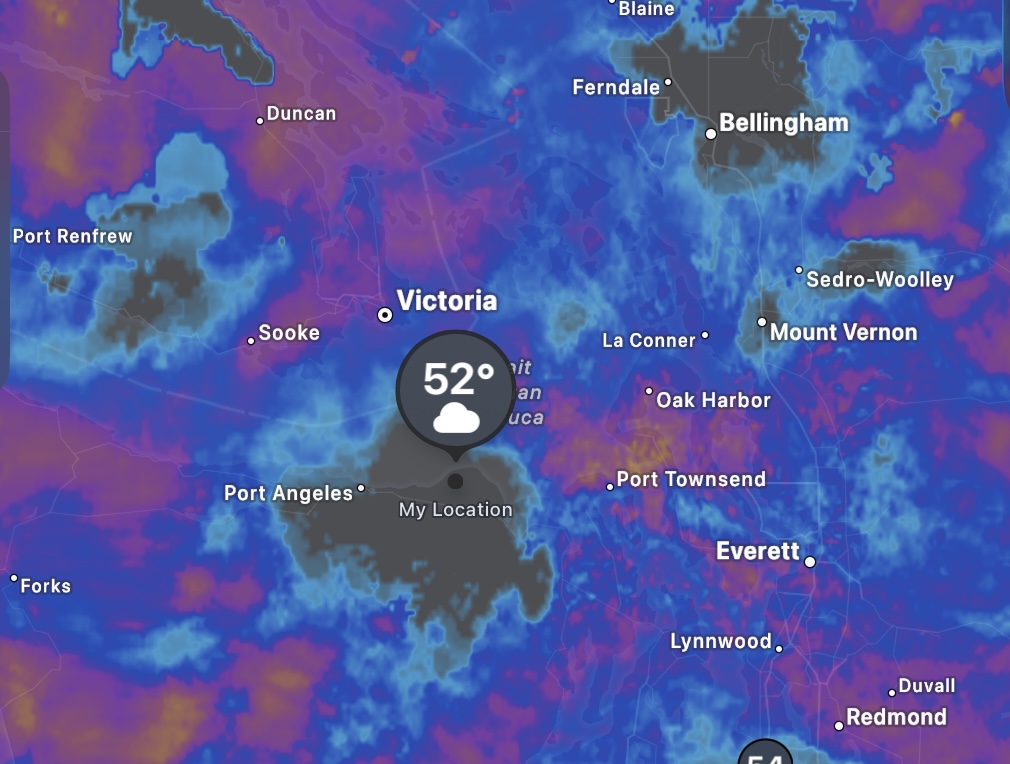
I have to be honest with you — one of my favorite things about living in Sequim is looking up at the sky.
I know that sounds simple. But when you’ve lived in Western Washington long enough, you know that a blue sky in the middle of winter feels like a small miracle. And in Sequim, it happens all the time. While Seattle is buried under a blanket of grey, while Olympia is soaked, while even Port Angeles is getting a good soaking — there’s a glimmer of blue right over the Dungeness Valley. Sometimes more than a glimmer. Sometimes a wide, brilliant, fully sunny afternoon that makes you feel like you’re living in a completely different climate than the rest of the state.
You are, actually. And there’s a name for it.
It’s called the Sequim Blue Hole. And the science behind it is one of the most fascinating weather stories in the entire Pacific Northwest.
What Is the Sequim Blue Hole?
The Sequim Blue Hole is the informal name for the patch of clear sky that regularly appears over Sequim and the surrounding Dungeness Valley — even when the rest of Western Washington is socked in with rain and clouds. Airline pilots flying over the region have noticed it for decades — a literal hole in the cloud cover, sitting right over Sequim like nature drew a circle around it.
It isn’t magic. It’s the Olympic Rain Shadow — and once you understand how it works, you’ll never look at the Olympic Mountains the same way again.
How the Olympic Rain Shadow Works
Here’s the science, explained as simply and clearly as I can.
Most of the storms that soak Western Washington come rolling in from the Pacific Ocean out of the southwest. They carry enormous amounts of moisture picked up over thousands of miles of open ocean. When those storms hit the Olympic Peninsula, they slam into something they cannot get around — the Olympic Mountains.
The Olympic Mountains rise to over 7,000 feet. They act like a massive wall, or more accurately, a ramp. As the moisture-laden air hits the southwestern face of the mountains, it has nowhere to go but up. As it rises, it cools. And as it cools, something happens: all that moisture it was carrying condenses out — first as clouds, then as rain, then as snow higher up. The mountains essentially wring the storms out like a sponge.
This is why the western slopes of the Olympic Mountains are covered in one of the most extraordinary environments on earth — the Hoh Rain Forest and the broader Olympic Rain Forest, which receives between 140 and 200 inches of rain every single year. Forks, Washington, on the western side of the Peninsula, gets over 120 inches of rain annually. It is one of the wettest places in the entire continental United States.
Now here’s where it gets interesting.
By the time that same storm air climbs over the Olympic peaks, it has already lost most of its moisture. It’s been wrung out. But then something else happens — as the now-dry air descends down the northeastern slopes of the Olympics toward Sequim, it actually warms and dries out even further. Sinking air compresses and warms, which lowers the relative humidity and causes any remaining clouds to evaporate. The result is air that arrives over Sequim drier than when it started — and a sky that opens up into that distinctive patch of blue even as clouds and rain surround it on all sides.
That opening in the clouds — visible from the air as a literal hole — is the Sequim Blue Hole.
The Numbers Are Staggering
If you grew up in Seattle or anywhere else in Western Washington, the rainfall numbers for Sequim will genuinely surprise you.
Seattle receives about 38 inches of rain per year. Olympia gets around 50 inches. Forks gets over 120 inches. Even Palm Springs, California — one of the driest and hottest cities in America — gets about 17 inches of rain a year.
Sequim gets between 13 and 17 inches of rain per year.
Let that sink in. Sequim, Washington — sitting in the heart of the famously grey and rainy Pacific Northwest — is drier than Palm Springs. It receives less annual rainfall than Dallas, Texas. It gets roughly the same amount of rain as Los Angeles.
And unlike Los Angeles, Sequim has the Olympic Mountains, the Strait of Juan de Fuca, old-growth forests, lavender fields, and one of the most beautiful natural settings on the planet right outside the window.
How Far Does the Blue Hole Reach?
The rain shadow effect isn’t limited to Sequim alone, though Sequim sits at its very heart and benefits from it most dramatically. Depending on the weather system moving through, the blue hole can expand to cover Port Angeles, Port Townsend, the southern San Juan Islands, and even parts of Victoria, British Columbia across the water.
Port Townsend receives about twice Sequim’s annual rainfall — still dramatically less than Seattle. Port Angeles gets roughly 27 inches per year. As you move further from the center of the rain shadow, the effect gradually fades — but even on the edges of it, the difference compared to the rest of Western Washington is striking.
The driest spot of all, interestingly, isn’t downtown Sequim — it’s Port Williams, just northeast of town along the Dungeness Spit, which sits at the absolute center of the rain shadow and records some of the lowest annual rainfall totals in the region.
What It Feels Like to Live Here
I moved to Sequim and I can tell you — the weather is one of the first things you notice, and it never stops feeling like a gift.
In the depths of January, when Seattle friends are posting grey sky photos and counting the days until spring, I’m often watching a pink sunset over the Strait of Juan de Fuca from my neighborhood. On winter mornings when the whole region is under a thick marine layer, there’s almost always a crack of blue somewhere over the Dungeness Valley. It might be a narrow band of sky between clouds. It might be a full, brilliant, sunny afternoon that has you eating lunch outside in January.
The locals call the area the Banana Belt — a tongue-in-cheek nod to the warmth and sunshine that sets Sequim apart from its neighbors. And once you’ve experienced a winter here, you understand completely why people who discover Sequim tend to stay.
What the Blue Hole Means for Life on the Olympic Peninsula
The Sequim Blue Hole isn’t just a weather curiosity. It shapes everything about life here — the farms, the lavender fields, the golf courses, the outdoor lifestyle, and yes, the real estate market.
Sequim’s sunshine and mild, dry climate make it one of the most attractive retirement and relocation destinations in the entire Pacific Northwest. People come from Seattle, Portland, California, and all over the country — drawn by the weather, the beauty, and the pace of life that the Olympic Rain Shadow makes possible.
The lavender farms that have made Sequim internationally famous? They exist because of the Blue Hole. You cannot grow commercial lavender in 38 inches of annual rainfall. But in Sequim’s dry, sunny microclimate, lavender thrives — which is why the Sequim-Dungeness Valley hosts one of the largest lavender festivals in North America every July.
The golf courses — including my personal favorite, the Cedars at Dungeness — advertise themselves as the driest courses in Western Washington. And they are, for exactly the same reason. Year-round playable conditions, firm fairways, and sunshine when everywhere else is soggy.
Thinking About Living Under the Blue Hole?
If you’ve read this far, I suspect you might be one of those people who pays attention to the sky. Who notices the quality of light. Who would genuinely appreciate waking up every morning in a place where the clouds part in a way that feels almost personal.
That’s Sequim. That’s the Blue Hole. And it’s one of the reasons I’m proud to call this place home — and proud to help others find their home here too.
I’m Jane Carhart, a real estate broker serving Sequim, Port Townsend, Port Angeles, and Port Ludlow. If the Olympic Peninsula has been calling to you, I’d love to show you around — blue skies included.
📞 Contact Jane Carhart today 🌐 janecarhart.com 📍 Serving the Olympic Peninsula: Sequim · Port Townsend · Port Angeles · Port Ludlow
Jane Carhart is a licensed real estate broker serving buyers and sellers across Washington’s Olympic Peninsula. Local knowledge, personal service, and a genuine love for this community — that’s what I bring to every transaction.