
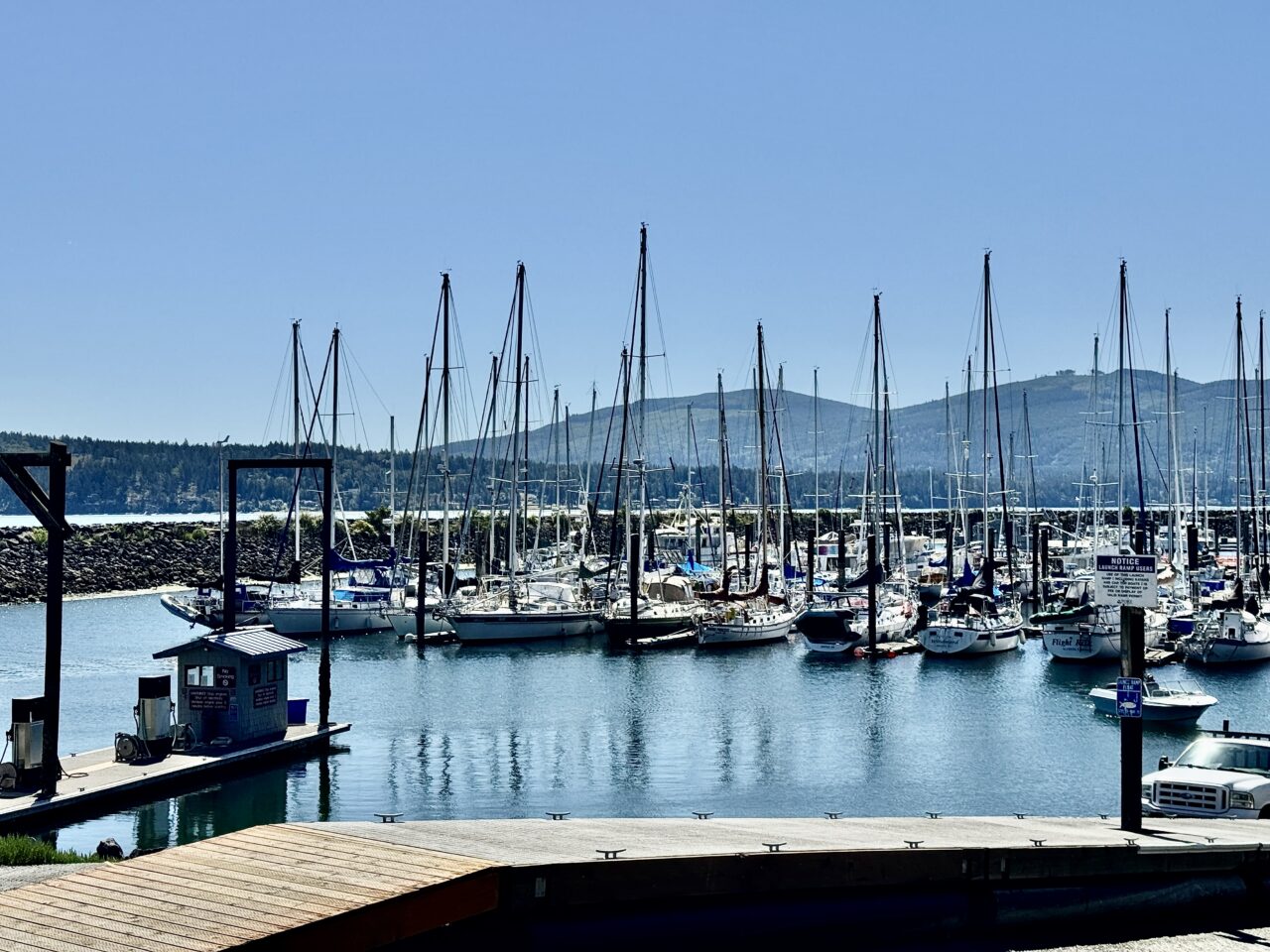
I have to tell you something about this part of the world that most people only ever see from a car window.
North Olympic Peninsula boating looks — and feels — completely different from anything you experience on shore.
The same coastline you drive past on Highway 101 — the one with the glimpses of blue between the trees, the occasional pullout where you stop and stare at the Strait for a few minutes before getting back in the car — that coastline transforms when you’re out on it. The Olympic Mountains rise behind you as you push away from the dock. The water opens up. And suddenly you understand, in a way that’s hard to explain to someone who hasn’t done it, why people have been pulling into these bays and harbors for centuries.
I live on the Olympic Peninsula. I know this stretch of coast the way most people know their neighborhood. And if you have access to a boat — or you’re thinking about it — I want to share the North Olympic Peninsula boating route that never gets old. Five ports of call, all within a comfortable cruising loop, each one completely different from the last — and every single one worth going back to.
North Olympic Peninsula Boating Starts Here: John Wayne Marina on Sequim Bay
If you’re going to start a North Olympic Peninsula boating adventure anywhere, it might as well be at a marina with a story this good.
John Wayne — the actor, the legend, the man who apparently had impeccable taste in Pacific Northwest real estate — spent years cruising Sequim Bay aboard his family yacht, the Wild Goose. He loved it here. Before he died in 1979, he’d already envisioned a marina on the bay’s eastern shore, and his family made that vision a reality in 1985 by donating 22 acres of land to make it happen. The Port of Port Angeles has run it ever since.
John Wayne Marina sits at Pitship Point on the east side of Sequim Bay, about 18 miles east of Port Angeles, and it’s one of the most complete marinas you’ll find anywhere on the North Olympic Peninsula. Fuel dock, pump-out, boat launch, showers, laundry, marine services, Wi-Fi — it’s all there. The Dockside Grill is the kind of waterfront restaurant you hope to find at the end of a long day on the water: seafood, sandwiches, local beers and wines, and views of the bay that make you want to stay for one more round. Learn more at the Port of Port Angeles website.
What makes Sequim Bay itself so appealing to boaters is the same thing that makes Sequim such a remarkable place to live: the protection. The bay is sheltered, calm, and surrounded by scenery that manages to be both dramatic and peaceful at the same time. The Olympic Mountains to the south. The lavender fields and the Dungeness Valley just a short drive from the docks. And if you time it right, that famous Sequim blue sky overhead — the same rain shadow sunshine I’ve written about before — making the whole bay shimmer.
From the marina, it’s worth making time for the Dungeness Spit, the longest natural sand spit in the United States and one of the most striking natural features on the entire Olympic Peninsula. You can see it from the water. Getting out to walk it is even better.
The Quiet Side of North Olympic Peninsula Boating: Discovery Bay
Discovery Bay doesn’t get talked about the way Port Townsend does, and that’s a big part of its appeal.
This is a deep, quiet inlet on the northeastern edge of the Olympic Peninsula, tucked between the Miller and Quimper Peninsulas where the Strait of Juan de Fuca narrows toward Admiralty Inlet. Captain George Vancouver sailed in here on May 2, 1792, named it after his flagship HMS Discovery, and apparently liked it enough to chart it carefully. There’s still a marker along Highway 101 commemorating that landing, which gives you a sense of how long people have been appreciating this particular stretch of water.
The bay runs about nine miles long and stays wide and protected — good anchoring, good fishing, and a pace of life that feels genuinely removed from the busier ports to the east and west. If you’re looking for a night on the hook away from the crowds, Discovery Bay is exactly that kind of place. Salmon jump here. Harbor seals show up without being asked. On a clear morning, the light on the water is something else entirely.
Just at the mouth of the bay, slightly to the north, sits Protection Island — a federally protected National Wildlife Refuge and one of the most significant seabird nesting colonies on the West Coast. You can’t land there, but seasonal boat tours operate out of nearby ports, and seeing the island from the water, covered in birds, is one of those experiences that stays with you.
Discovery Bay is the kind of stop where you slow down. Where you sit in the cockpit with a cup of coffee and just watch the morning come in. There aren’t a lot of those left.
The One That Stops You in Your Tracks: Port Townsend
I don’t know a single boater who has pulled into Port Townsend for the first time without stopping on the dock and just staring at it for a minute.
The approach from the water is genuinely dramatic. The Victorian waterfront rises above the bay in a way that looks almost like a stage set — all that ornate 19th-century architecture climbing the bluff, the Point Wilson Lighthouse marking the entrance to Admiralty Inlet to the north, ferries crossing in the distance. Port Townsend is one of only three nationally recognized Victorian seaport towns in the United States, and when you arrive by boat, you understand immediately why it earned that designation.
The Port of Port Townsend operates two marinas. The Boat Haven is the larger one — more than 400 slips, travel lifts for haul-outs, full services, everything you’d need for a longer stay or maintenance work. Point Hudson Marina is the one I’d send any North Olympic Peninsula boating visitor to first: it sits right at the edge of downtown, which means you tie up and you’re immediately steps from Water Street, the restaurants, the galleries, the brewpubs, and the kind of historic maritime town that most of the country has lost entirely. Plan your visit at the Port of Port Townsend.
Point Hudson offers 32 slips with 800 feet of linear docks, accommodating boats up to 70 feet, with power, water, showers, laundry, and pump-out on-site. Walk to the Point Wilson Lighthouse. Walk to Fort Worden State Park, a beautifully preserved coastal fortification with views across Admiralty Inlet that will make you want to just stand there for a long time.
And if you happen to be there in September, the Port Townsend Wooden Boat Festival turns the entire waterfront into something extraordinary — the largest display of wooden boats in North America, with sailing demos, boatbuilding exhibitions, and a maritime energy that fills the whole town. It’s worth planning an entire cruise around.
The Hidden Gem: Port Ludlow
If there’s one stop on this cruise that consistently surprises people, it’s Port Ludlow.
Tucked into a sheltered bay at the northern tip of Hood Canal, just south of where it meets Admiralty Inlet, Port Ludlow is the kind of place that yacht club members quietly tell each other about and then feel slightly possessive of. I’ve been there with my own yacht club, and I’ll tell you exactly what happens: you pull in, you look around at the harbor, and you think — why haven’t I been coming here every year?
The marina at Port Ludlow is a full resort operation, and it’s beautifully done. Three hundred slips accommodating vessels up to 200 feet, which means it handles everything from a modest cruiser to a serious yacht with complete ease. Fuel dock, pump-out, free showers, shore power — all the practical stuff is there and well maintained. The staff consistently earns praise from visiting boaters for actually coming down to help with docking, which matters more than people give it credit for.
What elevates Port Ludlow above a typical marina stop is the setting and what’s built around it. The Resort at Port Ludlow sits right above the marina — the Fireside Restaurant is steps from the dock, and on a quiet evening with the harbor glassing off and the Olympic Mountains catching the last light to the west, it’s a genuinely lovely place to be. The protected harbor means you sleep well. The mornings are quiet in a way that’s getting harder to find.
From Port Ludlow, the cruising options in every direction are excellent. North takes you toward Port Townsend, which makes these two stops natural partners on the same cruise. Southeast opens up Hood Canal and the routes toward Poulsbo and Bainbridge Island. And the nearby waters — Mats Mats Bay, Oak Bay — offer some of the most pleasant protected cruising in the entire region. The canal’s waters fish well too, with salmon, crab, and shrimp seasons that local boaters plan their summers around.
Port Ludlow also happens to be one of the towns I serve as a real estate broker, and I’ll just say this: the people who discover it by boat tend to be the ones who eventually start asking questions about living here. There’s something about arriving somewhere by water that lets you see it the way it actually is.
Where the Mountains Meet the Water: Port Angeles on the North Olympic Peninsula
Port Angeles is the hub of the North Olympic Peninsula — the largest city on this stretch of coast, the gateway to Olympic National Park, and home to one of the most strategically situated marinas in the Pacific Northwest.
The Port Angeles Boat Haven has been here since the late 1940s, protected by Ediz Hook — a long, curving sand spit that reaches east into the Strait of Juan de Fuca and creates a harbor that stays sheltered even when conditions outside are genuinely rough. The marina runs 300 slips, with a fuel dock, boat launch, haul-out services, showers, laundry, and a chandlery. The Olympic Discovery Trail runs directly past the marina, which means you can leave the boat and be on a 25-mile paved trail within minutes of tying up.
But what really sets Port Angeles apart as a cruising destination is what’s behind it. Olympic National Park — a UNESCO World Heritage Site encompassing nearly a million acres of pristine wilderness — is essentially in the marina’s backyard. Hurricane Ridge, with its sweeping alpine views, is 17 miles up the mountain from the waterfront. Sol Duc Hot Springs, ancient rainforest trails, and some of the most dramatic wilderness scenery in the continental United States are all within reach of a day’s excursion from the dock.
For boaters who want to extend the adventure across the border, Port Angeles is also Washington’s year-round ferry gateway to Victoria, British Columbia — a crossing that takes about 90 minutes and delivers you to one of Canada’s most beautiful cities. Make sure your documentation is in order, but if it is, a Victoria day trip from the marina is one of the better ways to spend an afternoon on this cruise.
Whale watching charters operate out of Port Angeles seasonally, and the Strait here is productive — orcas, gray whales, and humpbacks all move through. The downtown restaurant scene along First Street has improved significantly in recent years, and provisioning here is easy before pushing back out onto the Strait.
A Few Things Worth Knowing Before You Go
The Strait of Juan de Fuca is not a lake. Even in summer, conditions can build quickly — strong afternoon westerlies are common, and tidal currents run hard near Admiralty Inlet and around Protection Island. Experienced Pacific Northwest mariners will tell you to leave early in the morning, before the wind fills in, and to monitor VHF Channel 16 and the NOAA weather channels continuously. That’s good advice.
Transient moorage at the popular stops — especially Port Townsend in peak summer — can fill up. Call ahead to the harbormaster, or monitor VHF for availability. For John Wayne Marina, the harbormaster can be reached at (360) 417-3440. Point Hudson Marina in Port Townsend is at (360) 385-2828.
The best window for this cruise is late June through September. July and August offer the most settled weather, the longest days, and the full range of marina services. September is a local favorite — fewer crowds, beautiful light, and the Wooden Boat Festival in Port Townsend if the timing lines up.
The View From the Water
There’s a reason I keep coming back to the idea that North Olympic Peninsula boating looks different from anything you see on shore. The Olympic Mountains feel closer. The coastline reveals things you can’t see from the road. And the towns — Sequim, Discovery Bay, Port Townsend, Port Angeles, Port Ludlow — each have a waterfront character that’s entirely distinct from what you experience arriving by car.
If you’ve been thinking about making this cruise, make it. If you’ve been thinking about retiring somewhere with access to water this beautiful, this sheltered, and this alive — well, I might be able to help with that too. Take a look at what’s available on the Olympic Peninsula and let’s talk.
I’m Jane Carhart, a real estate broker serving Sequim, Port Townsend, Port Angeles, and Port Ludlow. This peninsula has been my home, and helping people find their place here is work I genuinely love.
📞 Contact Jane Carhart today
🌐 janecarhart.com
📍 Serving the Olympic Peninsula: Sequim · Port Townsend · Port Angeles · Port Ludlow
Jane Carhart is a licensed real estate broker serving buyers and sellers across Washington’s Olympic Peninsula. Local knowledge, personal service, and a genuine love for this community — that’s what I bring to every transaction.